
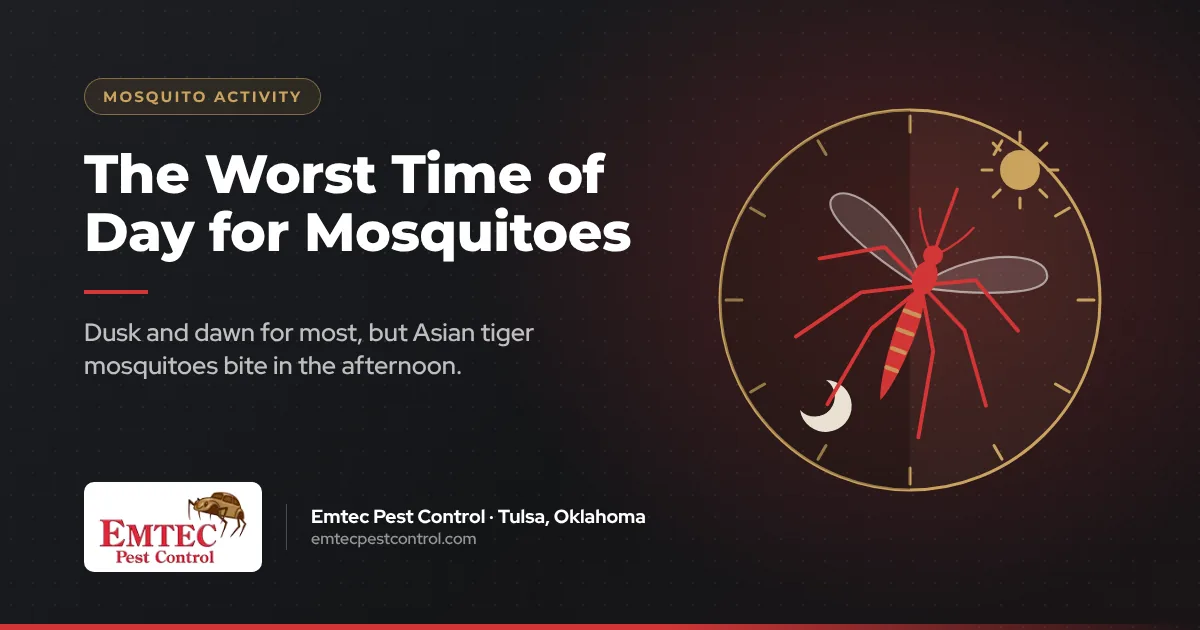
The worst time of day for mosquitoes is dusk and the first few hours of darkness, with a second, smaller peak around dawn. That is when most species, including the house mosquitoes that carry West Nile virus, come out to feed. There is one big exception in Oklahoma: the Asian tiger mosquito, the black-and-white striped mosquito that is the most common biter in our towns, is most active in mid to late afternoon. The best time to be outside is the middle of a hot, sunny, breezy day, out in the open and away from shade and standing water.
Mosquito activity by time of day
| Time | Activity | Who is biting |
|---|---|---|
| Dawn | High | House mosquitoes finishing the night; floodwater mosquitoes |
| Morning | Low to moderate | Asian tiger mosquitoes in shade; others if disturbed |
| Midday (hot, sunny) | Lowest in the open | Mostly resting; tiger mosquitoes in shady spots |
| Mid to late afternoon | High for tiger mosquitoes | Asian tiger and yellow fever mosquitoes |
| Dusk | Highest overall | Almost every species |
| Night | High, falling as it cools | House mosquitoes (West Nile carriers), malaria mosquitoes indoors |
Why different mosquitoes bite at different times
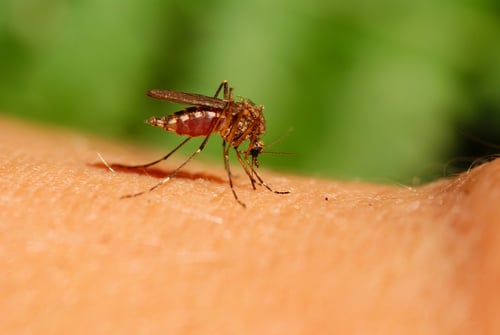
Daytime biters: Asian tiger and yellow fever mosquitoes
These two Aedes mosquitoes are black with white stripes and breed in small containers around homes. OSU entomologists call the Asian tiger mosquito the most important pest mosquito in most urban areas of Oklahoma from early June through fall, and note it is most active in mid to late afternoon. That is why evening fogging often misses it. The CDC says these mosquitoes fly only a few blocks in their lifetime, so if you are getting bitten on your patio at 4 p.m., they were likely raised in your yard or a neighbor's.
Dusk-to-dawn biters: house mosquitoes
House mosquitoes (Culex) are plain brown and breed in foul water such as storm drains, ditches and clogged gutters. The CDC says they are most active from dusk to dawn and rest during the day in grass, shrubs and thick vegetation. These are the main carriers of West Nile virus in Oklahoma, which is why the Oklahoma State Department of Health stresses repellent "especially between dusk and dawn."
Evening and shade biters: floodwater mosquitoes
After heavy rain, floodwater mosquitoes hatch in huge numbers. OSU notes that the species active after spring flooding typically bite in the evening or when disturbed in shady areas, so mowing, gardening or walking through tall grass can set off a swarm even in daylight.
Are mosquitoes active at night?
Yes. Many people assume mosquitoes disappear after sunset, but house mosquitoes are just getting started. They feed through the night, and activity only drops off when the air cools. A mosquito that gets indoors is the worst case: inside, it is sheltered from heat and wind, and a sleeping person is an easy target. OSU notes that the common malaria mosquito often comes indoors to feed at night. Keep screens repaired, run the air conditioning, and close doors quickly in the evening.
When are mosquitoes least active?
- Midday heat and sun. Most mosquitoes avoid hot, dry, sunny air and rest in shade until evening.
- Wind. Mosquitoes are weak fliers. A breezy day, or a strong fan on the patio, keeps many of them grounded.
- Cool weather. Activity drops sharply on cold nights and in late fall, and a hard freeze ends the season.
- Dry spells. Fewer breeding sites mean fewer mosquitoes, though they crowd around any water that remains.
The exception to the midday rule is shade. Walk under trees, into tall grass or onto a covered deck at noon and you can still get bitten, especially by tiger mosquitoes.
The worst times of year
In Oklahoma, the worst stretch is mid to late summer. Asian tiger mosquitoes are a daytime pest from early June through fall, and the Culex mosquitoes that carry West Nile virus become more abundant in mid to late summer, when it is hot and dry (OSDH). Rain matters as much as the calendar: University of Illinois Extension notes that big hatches of biting mosquitoes typically follow heavy rain by about two weeks. Activity slows in fall and usually ends with the first hard freeze. See the Oklahoma mosquito ID guide for the full season.
Where mosquitoes are worst
- Near standing water: ponds with weedy edges, ditches, low spots that flood, storm drains and neglected pools.
- Anywhere containers hold water: buckets, flower pot saucers, tires, toys, tarps, birdbaths and clogged gutters.
- In dense shade: shrubs, tall grass, ivy and groundcover, wooded lot edges and under decks.
- Out of the wind: fenced, sheltered patios and screened areas with gaps.
How to plan around mosquitoes
- Put on repellent before dusk. Use an EPA-registered product with DEET, picaridin, IR3535, oil of lemon eucalyptus, PMD or 2-undecanone (CDC). OSU suggests reapplying about an hour before dusk if you will be working outside into the night.
- Cover up in the afternoon too if tiger mosquitoes are biting, not just at dusk.
- Wear loose, long sleeves and pants. OSU notes tiger mosquitoes can bite through thin fabric, so treat clothing with permethrin, never skin.
- Run a fan on the patio or porch.
- Mow and trim shrubs and tall grass where mosquitoes rest.
- Dump standing water at least once a week. It is the only way to cut the population at the source. Our mosquito prevention guide has a checklist.
How Emtec treats mosquitoes
You cannot plan every evening around mosquitoes. Our mosquito treatment pairs an adulticide, which kills adult mosquitoes, with an insect growth regulator, which stops eggs and young mosquitoes from developing. Technicians apply it with a backpack mister to the shrubs, foliage and shady spots where mosquitoes rest, including the undersides of leaves and the space under decks. Treating the resting spots is what reaches the daytime tiger mosquitoes as well as the night biters.
Mosquito exterminator in Tulsa and Oklahoma City
If dusk on your patio has turned into a swatting match, a mosquito exterminator can help you take it back. Emtec Pest Control has served Oklahoma homes since 1979. We serve Tulsa, Broken Arrow, Owasso, Jenks, Bixby, Sand Springs, Sapulpa, Stillwater, Oklahoma City, Edmond and nearby towns. Learn about our mosquito control service, see how to keep the rest of your yard bug-free in keeping your patio and deck pest-free, or contact us.
Frequently Asked Questions
What time of day are mosquitoes most active?
Most species peak at dusk and into the evening, with a smaller peak at dawn. The University of Kentucky notes that while some mosquitoes bite in the daytime, most are more active in the evening. In Oklahoma towns the exception is the Asian tiger mosquito, which OSU entomologists say is most active in mid to late afternoon.
What time do mosquitoes go away at night?
They do not. House mosquitoes (Culex) are active from dusk to dawn, according to the CDC, so they keep biting all night. Activity drops as the night gets cool, and on a chilly night they may stop well before morning, but in an Oklahoma summer, expect them until sunrise.
Are mosquitoes out during the day?
Yes. Asian tiger and yellow fever mosquitoes bite mainly in the daytime. Other mosquitoes rest in shade during the day and will bite if you walk into their resting spots, such as shrubs, tall grass and under decks.
When are mosquitoes least active?
In the middle of a hot, sunny, breezy day, out in the open. Mosquitoes lose water quickly in dry heat and struggle to fly in wind, so they rest in shade until evening. Cold weather also shuts them down. Late summer evenings after rain are the opposite: the worst time of all.
What time of year are mosquitoes worst in Oklahoma?
Mid to late summer. Asian tiger mosquitoes are a pest from early June through fall, and the Oklahoma State Department of Health says the Culex mosquitoes that carry West Nile virus become more abundant in mid to late summer. Big hatches also follow heavy spring and summer rains by about two weeks.
Sources
- About Culex Mosquitoes (opens in new tab)
- Life Cycle of Aedes Mosquitoes (opens in new tab)
- Oklahoma Mosquitoes and Zika (Pest e-Alert, June 2016) (opens in new tab)
- Follow research-based mosquito control recommendations (opens in new tab)
- Mosquitoes: Practical Advice for Homeowners (ENTFACT-005) (opens in new tab)
- Oklahoma Experiences First West Nile Virus Case, and Death, of the Year (July 2024) (opens in new tab)
- Preventing Mosquito Bites (opens in new tab)