
If you found winged termites inside your house, termites are almost certainly feeding somewhere in the structure. OSU Extension and the University of Kentucky both say swarmers indoors indicate an infestation unless they flew in through an open door or window. The good news: the swarmers can't hurt anything, termites damage wood slowly, and you have time to deal with it properly. Here is what a swarm means, how to be sure they are termites, and what to do in the next few days.
What to do right now
- Vacuum or sweep them up. The University of Kentucky notes that swarmers can't damage wood and live only about a day indoors.
- Save a few. Put several in a sealed bag or a small jar so they can be identified. A clear photo of the wings and antennae helps too.
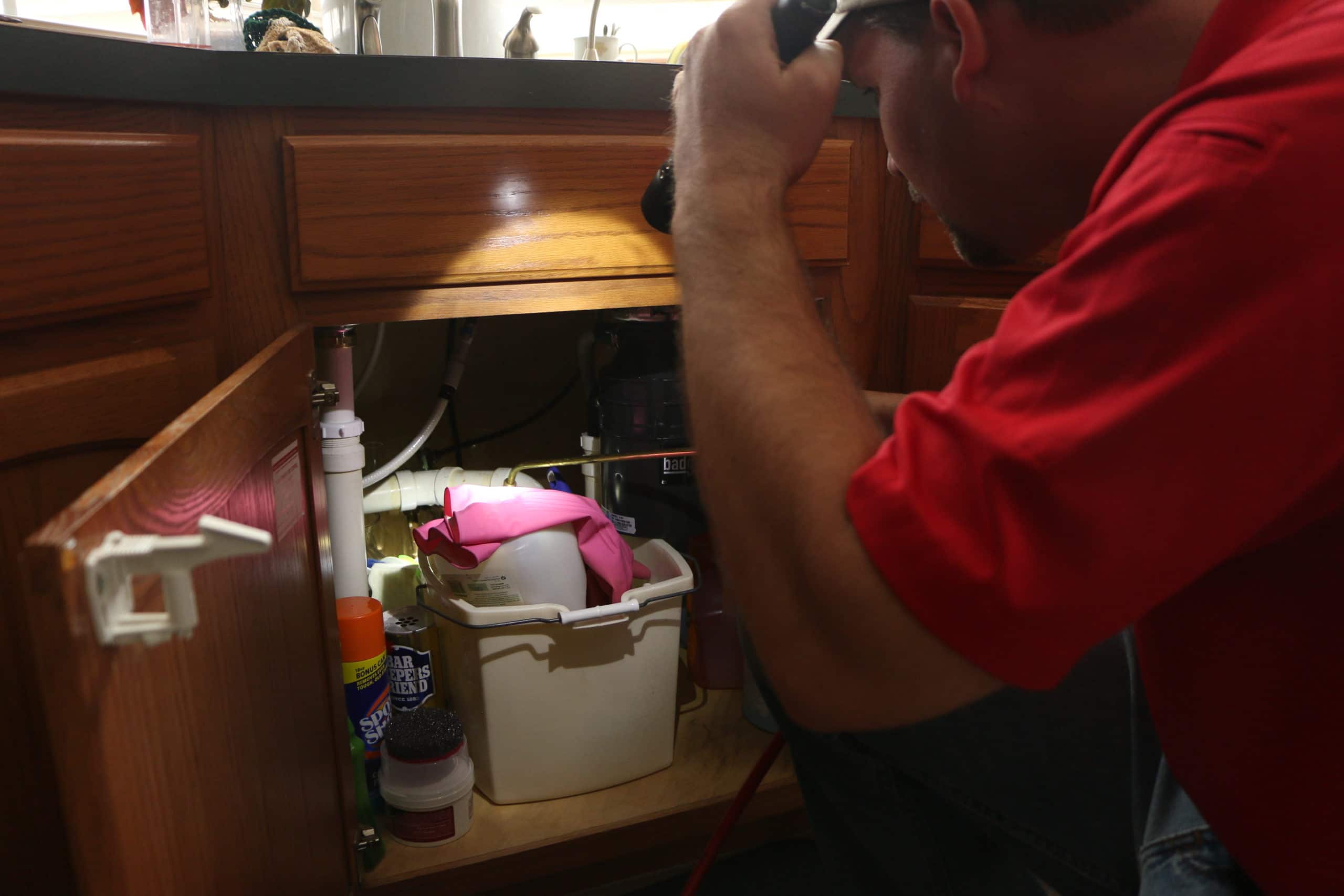
- Note where they came from. Swarmers pour out of a gap near where the colony is feeding: a crack in the slab, a baseboard, a window frame, a wall outlet, the tub drain. Mark the spot.
- Skip the bug spray. Spraying swarmers does nothing to the colony underground, and the swarm will end on its own.
- Look for other signs. Check the foundation and crawl space for mud tubes and probe nearby wood. See signs of termite damage.
- Schedule an inspection. A swarm confirms termites but not where they are feeding or how much damage there is. See what we check in a termite inspection.
Why termites swarm
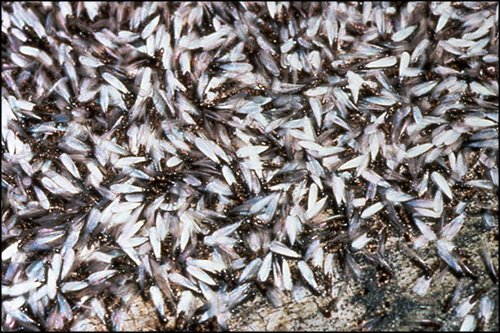
Swarmers are the colony's winged kings and queens. Once a colony is mature, it sends them out to mate and start new colonies. UF/IFAS entomologists say a colony may take five to ten years to grow large enough to produce swarmers, so a swarm comes from an established colony, not a new one.
After a short flight, the swarmers drop their wings, pair off and look for moist soil or wood to start a nest. Most never make it. Indoors they are drawn to light, so they end up on windowsills and in light fixtures and die there.
When termites swarm in Oklahoma
According to OSU Extension, March, April and May are swarming months in Oklahoma, and swarms sometimes appear in September or October as well. Warm weather after spring rain sets them off. Eastern subterranean termites, Oklahoma's most common species, swarm during the day; UF/IFAS describes their flights as happening on warm, calm days, often in the early afternoon after rain. Texas A&M AgriLife notes that the timing shifts with heat, day length and moisture, so a warm spell can bring an early swarm.
A colony may release several groups of swarmers over a few days, so a second swarm soon after the first is not unusual.
Is it a termite or a flying ant?
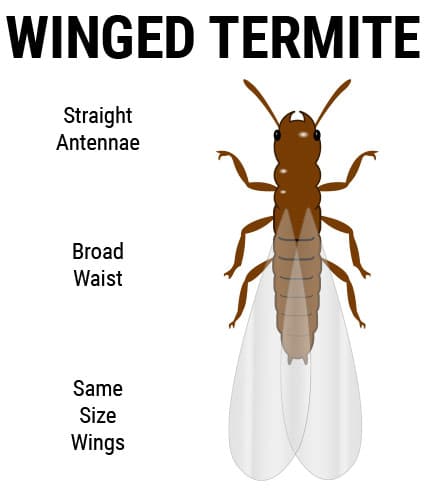
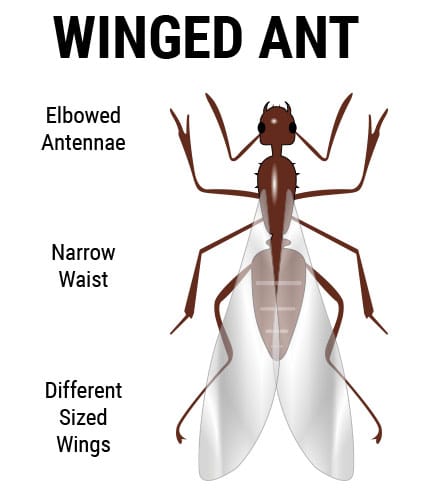
Flying ants swarm in spring too, and most "termite" calls we get turn out to be ants. Check three things (OSU Extension, EPA):
| Termite swarmer | Flying ant | |
|---|---|---|
| Waist | Broad and straight-sided | Narrow, pinched waist |
| Antennae | Straight, beaded | Bent at an elbow |
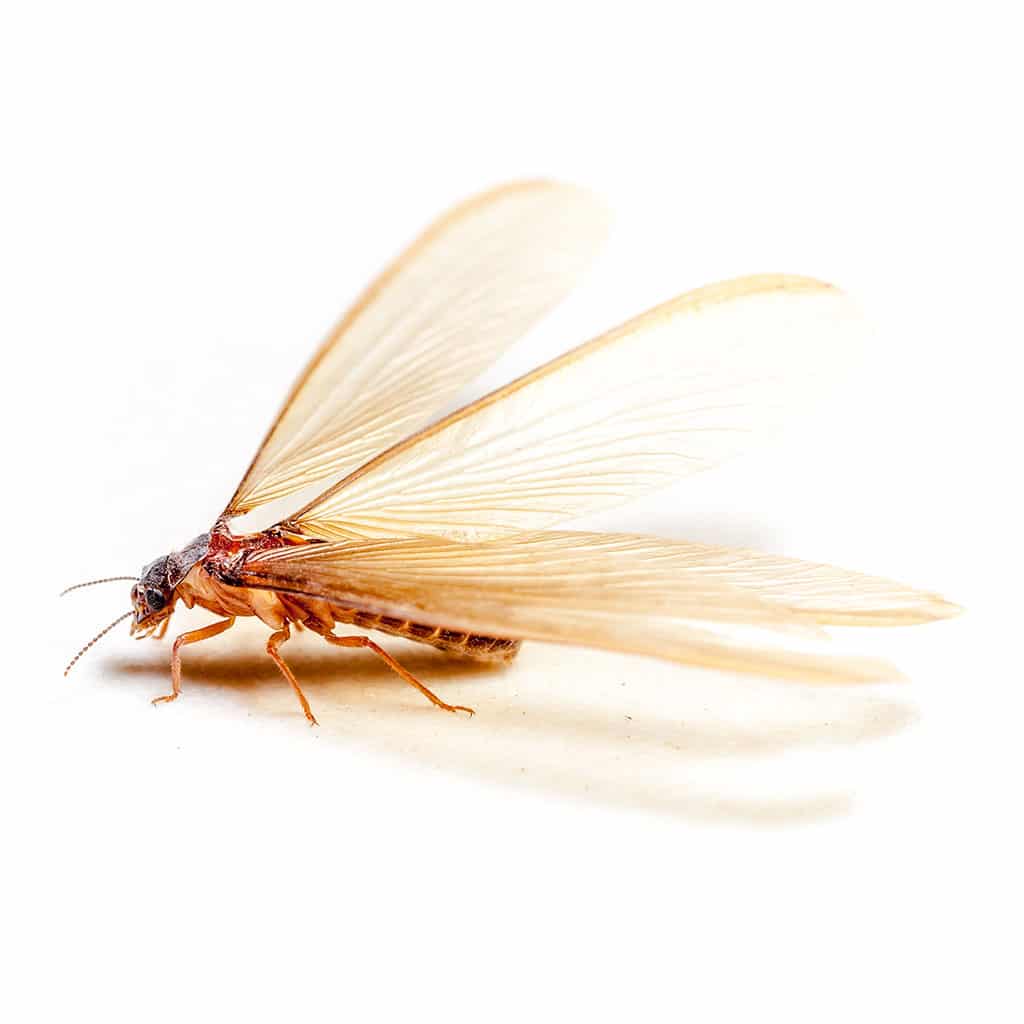
| Wings | Two pairs the same size, extending well past the body | Front pair larger than the back pair |
| Wings shed? | Yes, quickly, leaving piles of identical wings | Sometimes; wings are unequal |
Texas A&M adds that termites leave tiny wing stubs after their wings break off. If you find a pile of identical, see-through wings on a windowsill with no insects, it is almost always termites. More photos are on our ants vs. termites page.
Swarmers inside vs. outside
- Inside the house: almost always an infestation in the structure. Schedule an inspection.
- Beside the foundation, or from an attached porch, patio or deck: the University of Kentucky says this suggests the home may be infested. Get it checked.
- From a stump, woodpile or fence across the yard: not necessarily cause for concern, according to the University of Kentucky. It does mean colonies are nearby, so remove wood debris close to the house and keep an eye out.
Why a swarm is not good news
Some homeowners see a pile of dead swarmers and assume the termites are gone. They aren't. The colony that sent them is still in the soil, still feeding, and its workers stay hidden in the soil and wood. Swarmers are simply the part of the colony you can see. OSU Extension says swarmers are the reason most homeowners call a pest professional, and that is the right call.
Dampwood termite swarms
An older post on our blog described dampwood termites swarming in late summer. Dampwood termites are not native to Oklahoma. OSU researchers note that they, like drywood termites, are occasionally brought in with lumber or furniture shipped from western states. UC IPM describes dampwood termites as larger termites that need wet wood and are drawn to lights after dark. If you ever find termites in wet, rotting wood, fixing the moisture problem and replacing the damaged wood is the main cure, but in Oklahoma it is far more likely to be subterranean termites feeding on wood softened by a leak.
How to prepare for swarm season
- Keep gutters clear and downspouts pointed away from the foundation (OSU).
- Rake wood mulch back at least six inches from exterior walls, and keep firewood off the ground and away from the house (OSU).
- Fix leaks under sinks, at outdoor faucets and from the AC condensate line.
- Break any wood-to-soil contact at steps, posts, lattice and siding.
- Walk the foundation in late winter and look for mud tubes before swarm season starts.
More detail is in what attracts termites to homes.
Termite exterminator after a swarm
A swarm is the most common reason Oklahoma homeowners first call Emtec Pest Control, and we have been answering those calls since 1979. A technician identifies the insects, finds where they came out and how the colony is getting in, checks for damage and explains your treatment options, from baiting with the Sentricon® System to liquid treatments. See how the two compare in Sentricon vs. liquid termite treatment. If you saw swarmers, call the termite exterminator serving Tulsa, Broken Arrow, Owasso, Jenks, Bixby, Sand Springs, Sapulpa, Stillwater, Oklahoma City, Edmond and nearby towns. Learn about our termite control service or contact us.
Frequently Asked Questions
Do termite swarmers mean I have termites in my house?
If they are inside, almost always. OSU Extension and the University of Kentucky both say winged termites indoors indicate an infestation, unless they flew in through an open door or window. Swarmers outdoors from a stump or woodpiles do not necessarily mean the house is infested.
When do termites swarm in Oklahoma?
Mostly March, April and May, according to OSU Extension. Swarms can also happen in September or October, but less reliably. They usually follow a warm spell and spring rain, and they happen during the day.
How do I get rid of termite swarmers?
Vacuum or sweep them up. The University of Kentucky notes that swarmers can't damage wood and live only about a day indoors. Spraying them does nothing to the colony in the soil that sent them, so the real fix is a termite inspection and treatment.
Are termite swarmers dangerous?
No. They don't bite, sting or eat wood. They are a warning sign, not a threat in themselves.
How long does a termite swarm last?
Not long. A swarm is usually over quickly, and swarmers that end up indoors die within about a day because they can't reach soil. A colony may release more than one group of swarmers over a few days, so seeing a second swarm is not unusual.
Sources
- Termite swarming season (Pest e-Alert, May 1, 2008) (opens in new tab)
- Be on the lookout for termites (opens in new tab)
- Termite Control: Answers for Homeowners (ENTFACT-604) (opens in new tab)
- Native Subterranean Termites (EENY-212) (opens in new tab)
- Subterranean Termites (E-368) (opens in new tab)
- Survey and morphology of Oklahoma termites (Brown, Kard and Doss) (opens in new tab)
- Drywood Termites (Pest Notes) (opens in new tab)
- Termites: How to Identify and Control Them (opens in new tab)